When and How to Refer for Mental Health Care
Most children and parents will have some distress or upset - so how do I know when a child or family needs additional help?
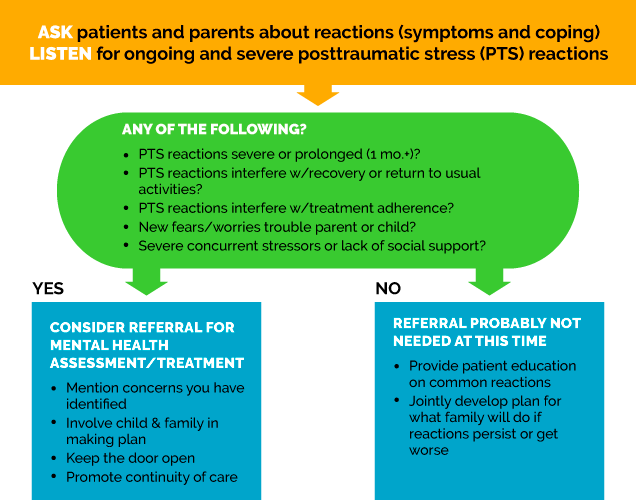
Ask your patients (and their parents) about reactions and coping.
Listen for ongoing or severe traumatic stress symptoms.
Consider a referral for a more thorough evaluation with a mental health professional if:
- Traumatic stress reactions are severe or prolonged (more than a month).
- Traumatic stress reactions interfere with recovery or with returning to normal activities.
- Consider: Is the child participating in daily activities to the extent possible given their medical condition? Are stress reactions interfering with treatment adherence? Are new fears or worries troubling the child or parent?
When to make a referral
Effective mental health treatment for traumatic stress
Online resources - help in finding a mental health professional
Distinguishing between types of mental health professionals
Therapist Resource Guide: There are many ongoing stressors that children and families endure after diagnosis of an illness or an injury. This guide focuses specifically on medical traumatic stress and responses that children and families may have.
Steps for making a referral
- Mention concerns you have identified.
- Say something like: "I'm concerned that (you are / your child is) having these upsetting thoughts and feelings. It might be useful to talk with a specialist who can help your family more."
- Involve child and family in making a plan.
- Ask for their ideas about what is needed now
- Say something like: "What issues or difficulties are impacting you / your family the most right now? What would help make things better?"
- Ask for permission to offer advice. Present advice as range of possibilities; be sure to incorporate patient/family ideas
- Say something like: "I have some suggestions that have helped other patients in the past in situations similar to yours. May I share them with you?"
- Range of possibilities might include: patient education materials / websites; speaking with social worker, local clergy, school counselor; seeking out support group, referral to therapist / community mental health center.
- Ask about their readiness to act on this now or in the future.
- Say something like: "Is this (suggested plan) something you would be willing to do when you leave today, or if you need it next week...month?"
- Ask about barriers to potential plans / referrals, and strategies to overcome barriers.
- Say something like: "What kinds of things would interfere with following-up on this plan we just discussed? How can we work through this so you end up getting the help you need.?"
- Ask for their ideas about what is needed now
- Involve the child and parent in setting the agenda*:*Adapted from Wissow et al. (2008)
- Keep the door open.
- If your patient or their parents are not quite ready to act on a suggested referral now, arrange to follow up to see how your patient is doing.
- You might say: "I'd like to talk with you again in a few weeks to see how things are going."
- Promote continuity of care.
- If your care for this patient is ending, ask permission to communicate your concerns about traumatic stress reactions or risk factors to the child's primary care provider, or to other providers who will continue to take care of this patient.
- Keep the door open.
Facilitating collaboration between pediatric health care and mental health providers: The American Academy of Pediatrics Task Force on Mental Health has developed tools to facilitate collaboration between pediatric health care providers and mental health professionals, including a Physician Referral and Feedback Form template
Effective mental health treatment for traumatic stress
There are very good and helpful treatments for children who continue to have traumatic stress symptoms.
What treatment approaches are effective?
Evidence-based treatments include cognitive-behavioral treatment approaches, and in particular Trauma-Focused Cognitive Behavior Therapy (TF-CBT). The National Child Traumatic Stress Network provides information on evidence-based treatments for youth trauma.
How can I help parents find effective treatment for their child?
When helping parents find a counselor or therapist to help their child with traumatic stress symptoms, you might suggest that they ask prospective therapists questions such as:
- Do you have experience working with children after trauma?
- What is your approach to working with this type of problem?
- What is your success rate?
- How do you work with parents?
Online resources - help in finding a mental health professional
The National Child Traumatic Stress Network (NCTSN) lists national resources for assistance with various types of child trauma.
The Society for Clinical Child & Adolescent Psychology provides useful information on effective treatment and finding a therapist - Effective Child Therapy: Evidence-based mental health treatment for children and adolescents
American Psychological Association - Psychologist Locator
National Association of Social Workers - Find a Licensed Social Worker
American Academy of Child and Adolescent Psychiatrists - Psychiatrist Finder
Anxiety Disorders Association of America - Find a Therapist
Sidran Institute Help Desk - Locate Trauma Resources
ISTSS Clinician Directory - Find a Clinician, Counselor or Mental Health Professional
Distinguishing between types of mental health professionals
- Psychologists are professionals who have earned a doctoral degree (Ph.D. or Psy.D.) after 4-6 years of graduate-level training in human behavior and development, psychological testing and evaluation, and psychotherapy. Psychologists are licensed by the state in which they practice.
- Psychiatrists are physicians (M.D. or D.O.) who have completed medical school, plus additional advanced training in the evaluation and treatment of psychiatric disorders and emotional and behavioral problems. Psychiatrists are licensed by the state in which they practice. As medical doctors, psychiatrists can prescribe and monitor medications.
- Clinical Social Workers are professionals who have earned a master's degree (M.S.W.) after 2-3 years of graduate training. Clinical Social Workers are licensed by the state in which they practice (LCSW or similar credential - varies by state).
- Marriage and Family Therapists are professionals who have completed a master's degree (M.A. or M.S.) after 2-3 years of graduate training. Some Marriage and Family Therapists have completed a required amount of clinical hours and passed a state-administered examination to become licensed marriage and family therapist (LMFT).
- Licensed Professional Counselors (LPC) & Licensed Mental Health Counselors (LMHC) are mental health professionals who have earned a master's degree (M.A. or M.S.) after 2-3 years of graduate training and have obtained a required amount of clinical experience and passed a state-administered licensing examination.
For more information on the training and credentialing of mental health professionals, see Mayo Clinic: Mental health providers.