
Some children and families experience medical traumatic stress at the moment of a life-threatening injury or at the time of diagnosis. However, potentially traumatic events occur all along the continuum of care. By keeping a trauma-informed perspective in mind, healthcare providers can try to minimize the potentially traumatic aspects of care within their own environments, and reduce the likelihood of ongoing traumatic stress.
Providing Trauma-Informed Care in Each Phase of Children's Illness and Injury Experiences
The experience of an injury or illness often unfolds in phases that can help pinpoint targets for prevention and intervention.
Phases of medical traumatic stress*
Three stages of response with different implications for intervention.
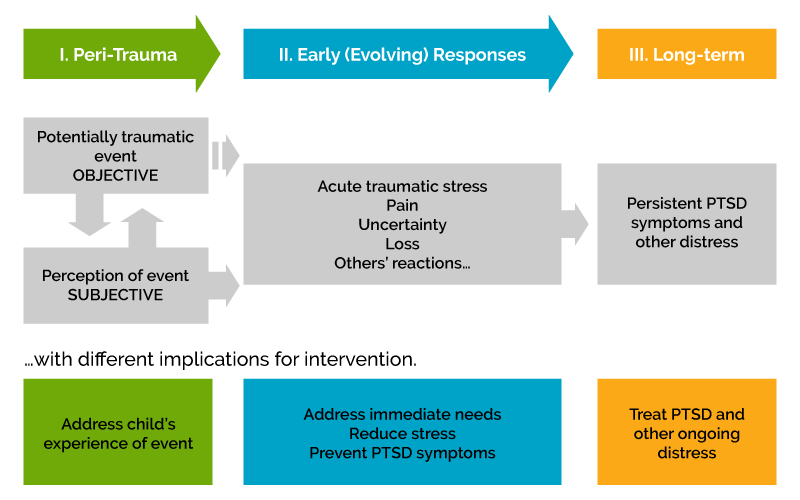
Phase I: Peri-trauma Providers caring for children as the initial events are still unfolding (in the midst of emergency care, giving a new and frightening diagnosis, carrying out procedures that may be painful or distressing) have the opportunity to reduce traumatic aspects of the experience for the child and family.
Phase II: Early (Evolving) Responses In the days and weeks that follow, the focus of intervention is addressing immediate emotional distress, promoting adaptive coping by the child and family (supporting existing strengths), and screening to determine who might need more support.
Phase III: Longer-term responses Providers in many settings have the chance to care for children over the long haul – and can be instrumental in continuing to support adaptive coping, detecting persistent traumatic stress reactions or other emotional sequelae, and referring children and families for psychosocial assessment and treatment.
Minimizing Pediatric Traumatic Stress At Key Intervention Points in Medical Care
In addition to injury or illness, the hospital and medical care itself can be traumatizing. Things that seem routine or familiar to professionals can be viewed as threatening and traumatic by children and families.
Fortunately, there are simple things that healthcare providers can do to minimize pediatric traumatic stress.
Each section below represents a critical juncture along the healthcare journey where children and families may experience traumatic stress. By incorporating a few of these simple tips for minimizing pediatric traumatic stress reactions into routine care, providers can have a significant impact on the way children and families experience the traumatic aspects of medical care.
Prehospital Care
Ambulance transport can be frightening to children, especially when they are separated from parents / caretakers.
Exposure to additional elements at the scene or during transport – blood, sirens, others who are hurt or injured – can be frightening.
To minimize traumatic stress for families:
- Provide simple explanations about what is happening and what will happen next.
- Minimize additional exposure to traumatic elements at the scene or during transport.
- Encourage parent presence, and support parents in remaining a calm presence for their child.
Emergency Care
The sights and sounds of the ER can be frightening for children.
Being in pain and being separated from parents are two significant risk factors for persistent traumatic stress in children.
In the ER, children who appear calm and quiet may not tell you what they are thinking or feeling, or that they are worried and anxious.
To minimize traumatic stress for families:
- Explain that feeling worried, mad, sad, or confused is common and expected.
- Ask about fears and worries and provide simple explanations for medical procedures.
- Talk with the child at his/her eye level.
- Encourage parent presence and support parents in comforting their child.
Admission
Research suggests that an unexpected hospital admission is associated with increased risk for posttraumatic stress in children and parents.
Children and families can feel disoriented or in a daze during the admissions process, due to stress, fatigue, pain, or traumatic stress.
To minimize traumatic stress for families:
- Provide simple explanations about what is happening and what will happen next.
- Explain that feeling worried, confused, or numb is common and expected.
- Slow down the pace of your dialogue to match the child's or the parent's.
- Ask open-ended questions to check their understanding.
- Be willing to repeat important information.
Diagnosis and Treatment Planning
The time of diagnosis can be especially unsettling or traumatic for children and families. Their subjective perception of life threat is key.
Children and families may feel anxious and helpless during this process. Initial responses such as shock and disbelief, crying, feeling worried, angry, overwhelmed, or numb are common and often temporary.
In situations of high stress, children and families often absorb only part of the information they hear from the healthcare team.
To minimize traumatic stress for families:
- Explain that feelings of shock, disbelief, or worry are common and expected.
- Slow down your pace when delivering factual information.
- Be prepared to repeat important information.
- Ask open-ended questions about fears and worries (e.g. You look a little worried – what worries you the most?)
- Involve the child and parents as much as possible in treatment planning.
Inpatient Treatment
During an initial hospital stay, children and families often do not know what to expect. Processes that are routine for providers can seem awkward, unfamiliar, even frightening to children and families.
Newly admitted children and families may feel isolated, or isolate themselves as part of the adjustment process.
Parents may feel uncertain regarding their role while their seriously ill or injured child is in the hospital. They may feel helpless at seeing their child in pain or hooked up to medical equipment.
To minimize traumatic stress for families:
- Patiently orient families to the hospital environment.
- Explain, and normalize sights (e.g. medical equipment, other sick children) and sounds (e.g. codes) they may encounter.
- Help families establish daily routines and behavioral expectations.
- Involve children and families as much as possible in daily care and decision-making.
- Recognize parents / caretakers as experts on their child.
- Identify and incorporate family strengths and coping resources into treatment plan.
Painful Treatment and Treatment Setbacks
Common emotional responses to painful treatment and treatment setbacks include feeling sad, depressed, irritable, angry, scared, or withdrawing from others.
Some children and families experience a setback as a failure rather than a "bump" in the road.
Setbacks can also trigger a renewal of earlier distress and regression in emotion and behavior.
To minimize traumatic stress for families:
- Explain that feelings of anger, sadness, frustration, and fear are common and expected.
- Be open to expressions of strong emotions (including anger).
- Don't trivialize or dismiss worries or fears.
- Remember that "difficult" or angry parents are often scared or traumatized, trying to put up a tough front.
- Help children and families connect with their coping strengths and spiritual resources.
Rehabilitation
With the transition to rehab, children and families can become more anxious. Even when it is welcome, they may experience the transition as a loss, especially if it involves a change in providers or treatment team.
Children can experience significant pain, emotional loss, anger, or frustration when challenged to do something that once came naturally, but is now more difficult.
Traumatic reminders of the event often get triggered during rehab.
Children and parents sometimes get angry at providers for what they perceive as "pushing too hard" or for triggering reminders.
Children with physical injuries and limitations can feel different from peers and might withdraw from friends and family as a result.
To minimize traumatic stress for families:
- Explain that feelings of loss and frustration are common and expected, with the physical and emotional demands of rehab.
- Ask about and validate the child's or family's feelings of frustrations.
- Anticipate that trauma reminders might get triggered during rehab.
- Plan in advance with the child and family about how they will cope with challenges.
- Identify the child's strengths and coping resources and include in the rehab plan.
Discharge Planning
Even as they feel glad to go home, some families experience discharge from the hospital as a time when they lose medical support and a sense of safety. They may become anxious, agitated, argumentative, or avoidant as discharge nears.
Parents may feel uncertain how they will cope with the medical and treatment issues at home without frequent support.
Trauma triggers, flashbacks, and nightmares may intensify during this period. To minimize traumatic stress for families:
- Remember that as discharge nears, children and families typically experience both positive and negative feelings - relief at going home as well as worry, fear, or loss of a safety net.
- Help the family anticipate the medical, social, and emotional challenges of returning to the home environment.
- Help families identify coping strategies and resources they will use.
- Ask parents about what knowledge or skills they need to support caring for their child at home.
Outpatient Treatment / General Pediatrics
The transition from the hospital to home can be difficult for some children and families. Many children and families do not anticipate the need for adjustment.
Family members may become irritable and anxious while trying to re-establish daily routines, and may try to rush the normal adjustment process.
Children who look and feel different may worry about how their friends and peers will react and may avoid interacting with them at first.
Siblings may be affected too. They may be resentful of their ill or injured brother or sister but also feel guilty, and worry in private.
During the transition to home, parents might be especially anxious or hypervigilant regarding their child's safety. They may go out of their way to avoid places and people that trigger upsetting memories, or dealing with feelings they have put on hold. To minimize traumatic stress for families:
- Help families anticipate the need to adjust after illness or injury and to plan for it.
- For parents, explain that feeling anxious is common, and encourage them to gradually let go of unrealistic worries
- Remind parents that siblings can be affected too and to address their worries.
- Encourage ill or injured children to do things on their own, as appropriate, and stress the importance of setting normal behavioral limits.
- Help parents help their child reconnect with friends and plan activities as allowable, as well as prepare answers to common questions that their friends might ask.